[home] [about me] [publications] [software dev] [artbook]

𝖕𝖚𝖇𝖑𝖎𝖈𝖆𝖙𝖎𝖔𝖓𝖘

Common Subtree Merging Compressed Opacity Micromaps
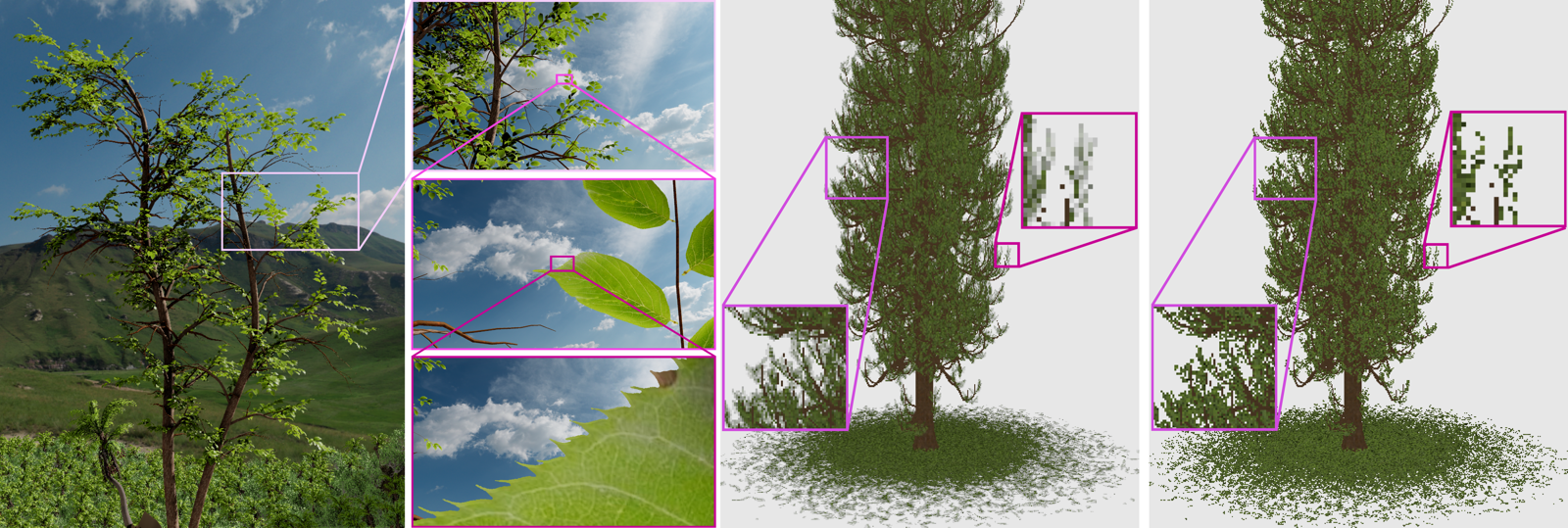
Left: A series of images zooming-in on the edge of a single leaf which is highly detailed. Right: A side-by-side comparison of the two renders of a pine tree. The left image shows a tree with smooth, alias-free edges. The right image has aliasing along the edges and details of the tree.

Thomas Chernaik, Jaina Modisett, Markus Billeter

29 June 2026

doi: 10.1145/3820017

Abstract: Alpha masked geometry is very prevalent in 3D scenes. It is commonly used to express complex shapes while limiting the need for additional polygonal geometry. A predominant use case is foliage rendering, where leaves often have complex and curved edges with fine detail. Opacity micromaps (OMMs) provide a substantial improvement to ray tracing alpha masked geometry. We present a novel method of lossless compression for opacity micromaps using common subtree merging that supports real-time random access without decompression. We demonstrate reductions in memory usage of up to two orders of magnitude compared to standard OMMs, with similar rendering performance. Our method includes aggregate hierarchical opacity for OMMs. With it, we can estimate the opacity at intermediate levels of detail, making it possible to reduce aliasing from fine detail. Further, we demonstrate that our compression can be applied to binary alpha mask textures, requiring as little as 0.05 bits per texel.
Encoding Occupancy in Memory Location for Efficient and Compact High-Resolution Voxel Structures

📣 I presented this at Eurographics 2026! 📣

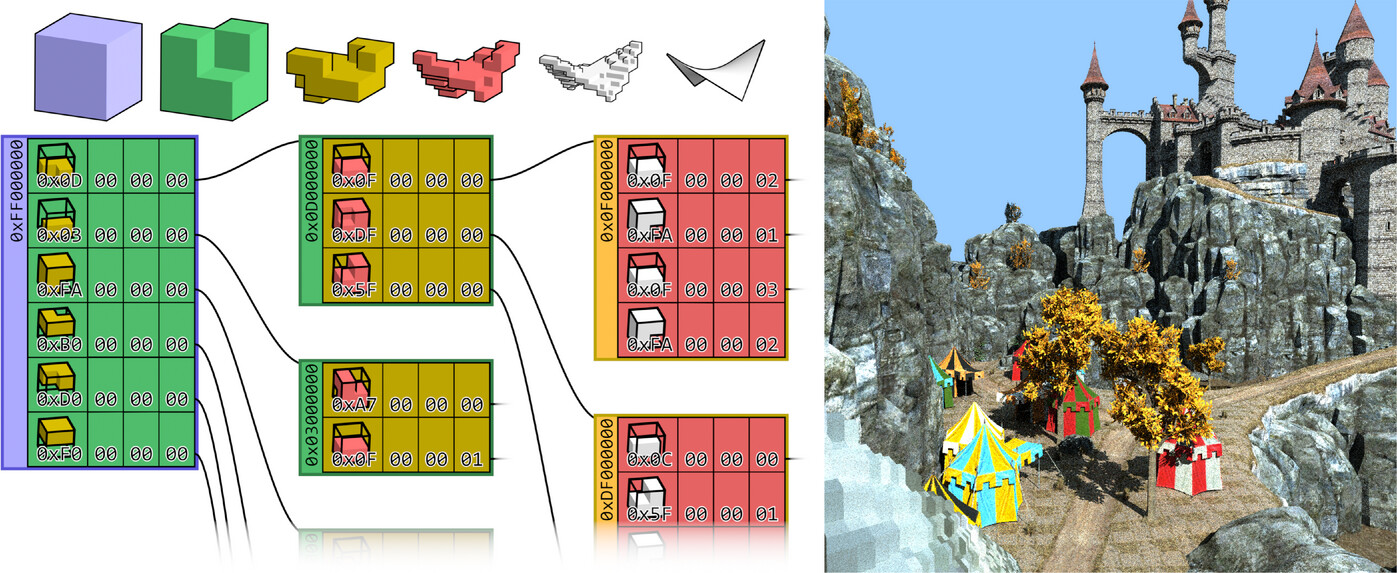
A tree diagram. Each node shows a small group of voxels and a memory address. Beside it is a colorful render of the castle from the Epic Citadel scene.

Jaina Modisett, Markus Billeter

21 November 2025

doi: 10.1111/cgf.70292

Abstract: Compressed voxel structures make it possible to store, interact with and display detailed and complex geometry. The Sparse Voxel DAG (directed acyclic graph) is such a compressed representation that supports real-time rendering and interactive editing of high-resolution voxel geometry. We present a novel encoding of the Sparse Voxel DAG that utilises the memory location of data to encode information about the structure of the voxel geometry. This encoding is not only more compact but also makes it possible to avoid memory accesses. In turn, this improves traversal performance, which we can observe in terms of increased ray tracing speed. Our new encoding retains compatibility with other existing methods. We demonstrate an adaption to the HashDAG data structure and show that our proposed encoding also results in better editing speed at similar memory requirements in this framework. Further, we demonstrate its compatibility with existing methods for storing voxel attributes such as colours.

Tracking and Control of Multiple Objects During Nonprehensile Manipulation in Clutter

A tree diagram. Each node shows a small group of voxels and a memory address. Beside it is a colorful render of the castle from the Epic Citadel scene.

Zisong Xu, Rafael Papallas, Jaina Modisett, Markus Billeter, Mehmet R. Dogar

6 June 2025

doi: 10.1109/TRO.2025.3577437

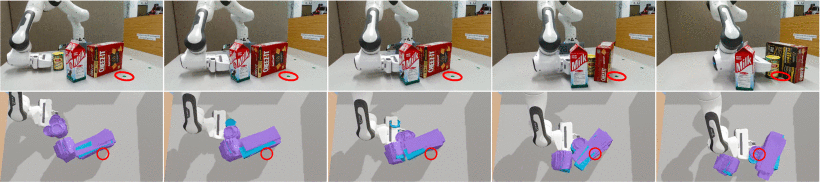
Abstract: This article introduces a method for 6-D pose tracking and control of multiple objects during nonprehensile manipulation by a robot. The tracking system estimates objects’ poses by integrating physics predictions, derived from robotic joint state information, with visual inputs from an RGB-D camera. Specifically, the methodology is based on particle filtering, which fuses control information from the robot as an input for each particle movement and with real-time camera observations to track the pose of objects. Comparative analyses reveal that this physics-based approach substantially improves pose tracking accuracy over baseline methods that rely solely on visual data, particularly during manipulation in clutter, where occlusions are a frequent problem. The tracking system is integrated with a model predictive control approach which shows that the probabilistic nature of our tracking system can help robust manipulation planning and control of multiple objects in clutter, even under heavy occlusions.